On Kateryna Lysovenko
Crossing thresholds and finding defiance in art

Kateryna Lysovenko’s art is my favourite discovery from 2025.
It’s early September days and it is the perfect time to be in Vienna. I am wandering across viennacontemporary art fair with a loosely set destination: visit ZONE1, the section spotlighting emerging artists strongly connected to the city.
From a distance, large-scale paintings shine almost fluorescent from the booth: the saturation absorbing the colour from the adjacent art. Pinks and oranges and yellows beckon attention, inevitably leading me to the works: as I attempt to convey my admiration, the gallerist (Warsaw-based contemporary art gallery TBA) swiftly leads me to the artist. Kateryna Lysovenko turns to me and the first thing I notice is her hot pink eyeliner. We immediately start talking.
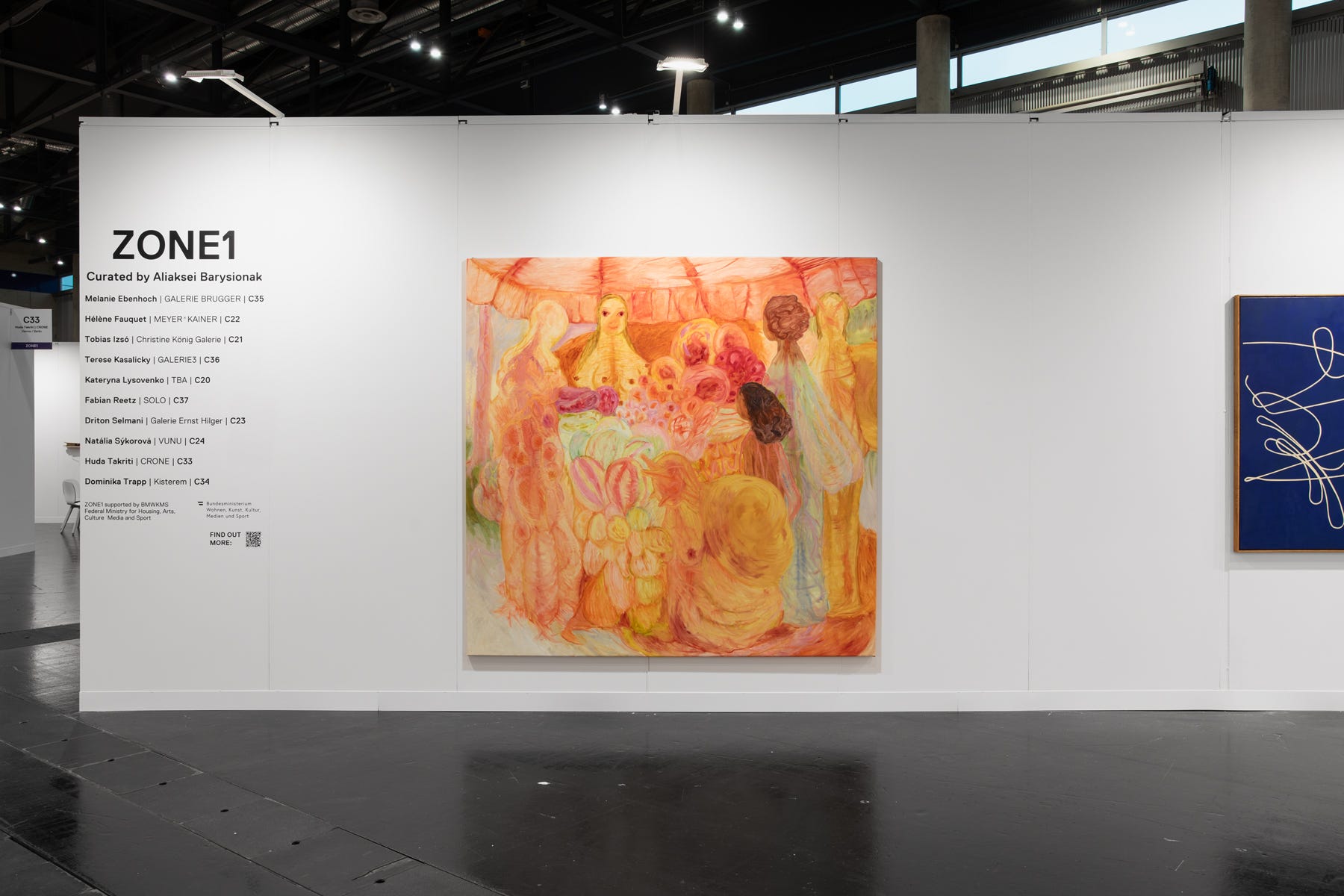
Kateryna Lysovenko, Vienna, fruit shop, dedicated to Privoz (Odessa market), 2025, Oil on canvas, 221 × 216 cm, Photo: Michał Matejko, Courtesy of the art gallery TBA in Warsaw, Poland
Ukrainian, born in Kyiv, Lysovenko escapes the Russian aggression to find refuge in Vienna. Before the offensive began, between 2014 and 2019, Kateryna studied at the National Academy of Fine Arts and Architecture in Kyiv. She attended the Social Realism School, which, she mentions, still survives now; despite the ending of the Soviet Union, the school continues to perpetrate regimented painting techniques. Kateryna’s education set the foundations to her compositions: whilst improving her technique, it smothered the intimacy with her paintings, setting rigid parameters. Across the fifteen years studying fine art, Kateryna pushed the mold until it cracked, determined to shed the inherited ideology and find her own way of painting.
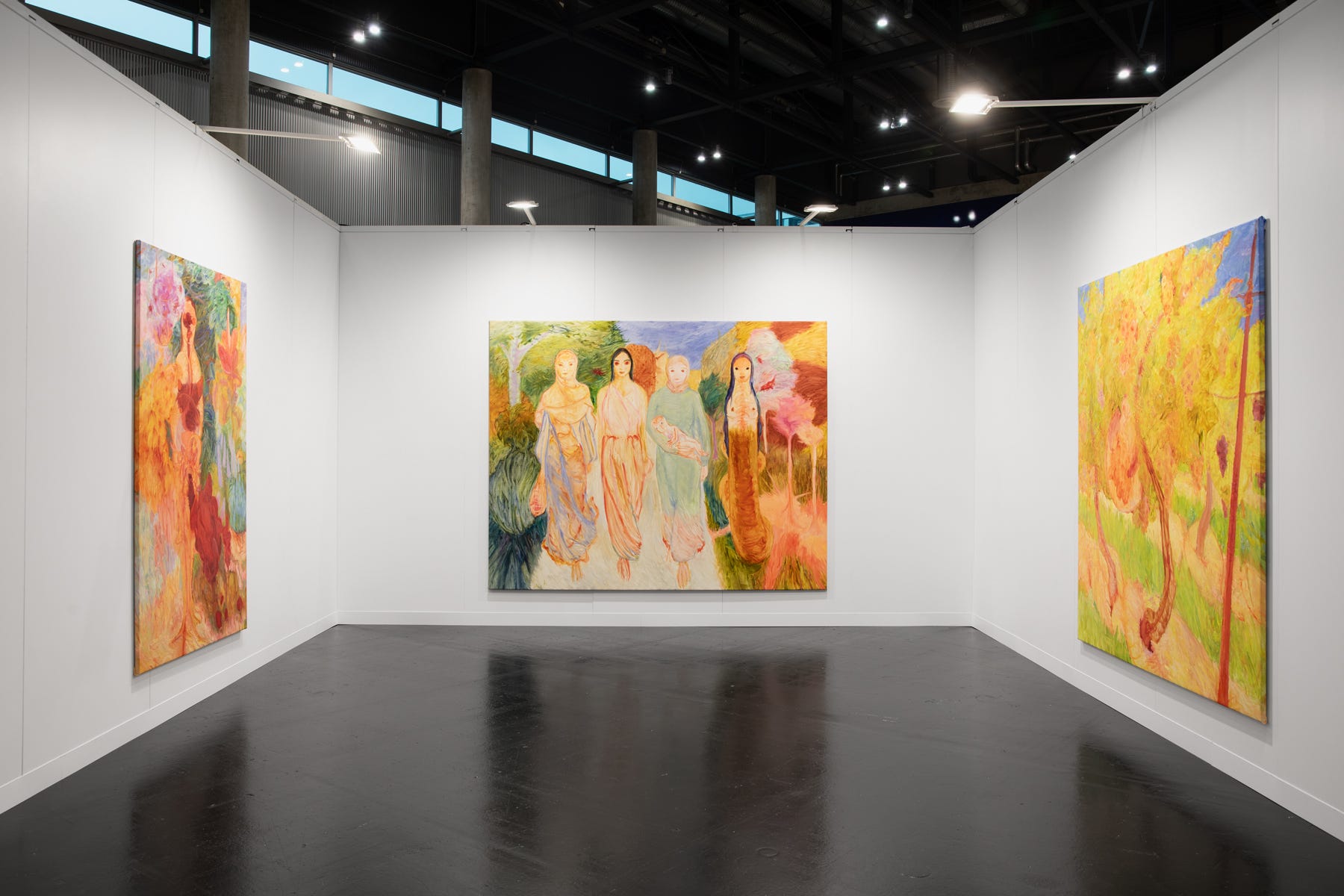
Booth of the art gallery TBA at Vienna Contemporary 2025, Photo: Michał Matejko, Courtesy of the art gallery TBA in Warsaw, Poland
Kateryna creates paintings from a place of radical awareness, a clear cut perspective of maturing her own method against the destruction around her. As she narrates her journey with art, she shows me an image from her monograph, a painting from a past that does not seem so distant after all. A bleak landscape made solely of barren soil frames a delicate but opaque white soul, emerging from a hole in the ground. Through her current works, what emerges, all around us, is her defiance.
“With this project, I wanted to show extremely clearly, the relationship between a victim and aggressor or between people who are under pressure and people who have no power. [...] When the war started I understood that between the victim and the aggressor, there is nothing. It felt like the world was empty and if the aggressor says they want to kill you, you will die. But then I understood there is no emptiness, even in the air we breathe. Paradoxically, the world showed me it was better than I thought. [...] I understood that everything has a matter and is important. Everything exists together with us, but we are also destroying it. When the rocket kills us, it wrecks everything. As I realised this, I started thinking about painting transparently: we are completely transparent to contemporary technologies, and proportionally, to the power of this technology of destruction. We are also helpless, like microorganisms. So when the rocket explodes now, you will not save your children. And so I realised: okay, we are fragile, but it’s not bad. And now I want to show this fragility and transparency; it’s good, like, it’s actually good. I like it. I developed my language and transformed it to show this new experience in this dynamic and the importance of everything which is around us.”
Kateryna Lysovenko
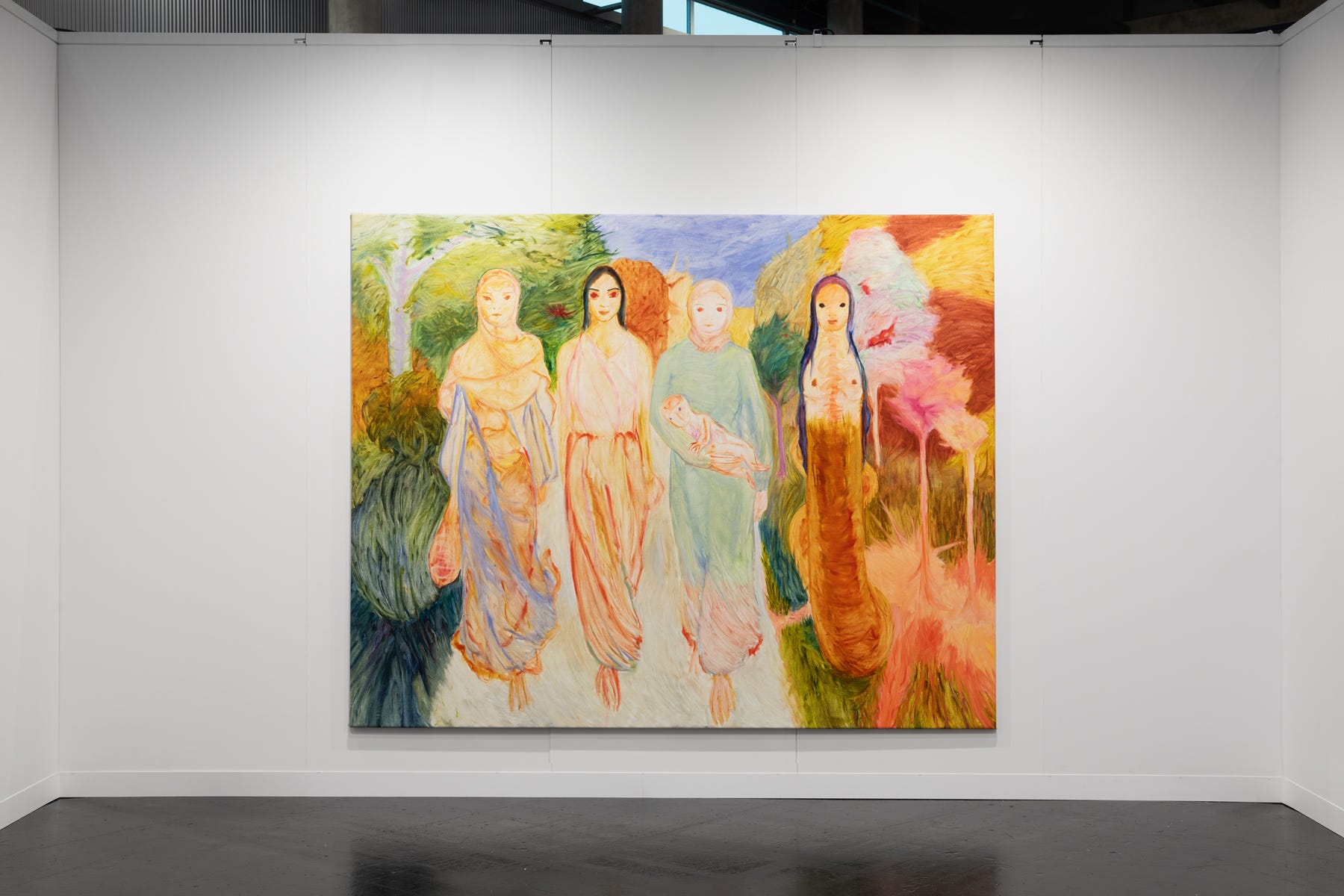
To be in Vienna, seeing people from another wars, 2025, Oil on canvas, 271 × 216 cm
Photo: Michał Matejko, Courtesy of the art gallery TBA in Warsaw, Poland
In the beat of silence of barely a second, I feel Kateryna’s grounding in vulnerability. Pushed to the edge, Kateryna released the overwhelming bleakness with an unyielding celebration of life; the clear cut, isolated figures from the past fade as the subjects in the canvases blend in with the background with energetic strokes, full of colour and vitality. Her current subjects lose the opacity of despair, and become physical manifestation of the emotional crossing the painter underwent. Some of the subjects’ skin is transparent, revealing the solid column of a spinal cord or the internal organs. They face the viewers with the sureness of feeling whole while in a state of vulnerability, and with their interiors made visible, they are made unquestionably alive.
“I created a space for the victims who were already killed to still exist. I don’t accept their deaths. My previous language was developed for showing dead people, you know? Even if we get killed–not only in Ukraine–we are still alive. This lightness and dynamic are important to me. Sometimes I see journalists or, for example, curators from the West or from other countries who didn’t face war and come to Ukraine and try to keep works in the frame of sadness, with a palette of white, black, gray. But, paradoxically, when you face war, when you become traumatised afterwards, life becomes super intense and colours become incredibly strong. Of course I don’t want to make a positive of the war, but life has more value during the war, not less. I now let my instincts and feelings and wishes be realised in these works and let my paintings have their own logic.”
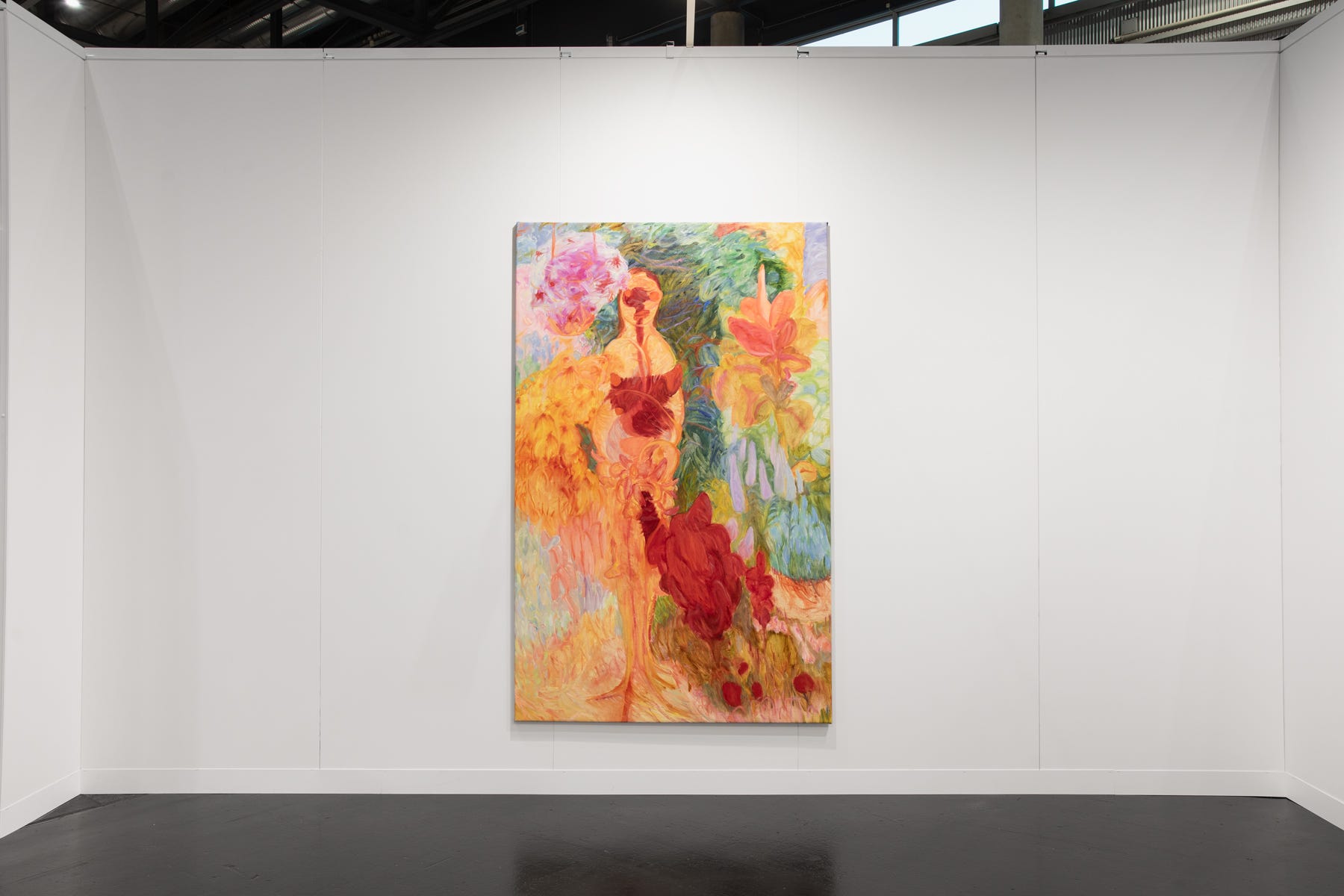
Kateryna Lysovenko,
Vienna, flowers seller, dedicated to my grandmother and Kateryna Bilokur, 2025
Oil on canvas, 216 × 139 cm, Photo: Michał Matejko, Courtesy of the art gallery TBA in Warsaw, Poland
Kateryna’s works remain with me as I thank her and continue exploring the fair. I am already back in London when I learn she and the gallery received the 2025 Münze Österreich Prize and see her smiling in the images.
In the months since having spoken to her, I look at the pictures on my phone feeling the energy flow across the screen. On the very same screen, the news of Ukraine’s resistance unravels, along with the several injustices plaguing the world. Looking at the images, I recognise in myself also having stepped over an edge. A desperate resistance starts shimmering, and the paradox of a pained but vibrant life becomes feasible, even asking to be normalised. The only possible place to settle within my heart is askew, demanding a constant commitment to facing the light. Through her art, unrelenting and unsmothered, Kateryna Lysovenko shines.